
A small, corroded iron sheet sits in the British Museum, prompting questions about the limits of ancient engineering.
The object, cataloged as EA2433, measures 23.5 centimeters by 7.9 centimeters and was reportedly excavated from the air-shaft of the Great Pyramid of Khufu at Giza. This artifact, often cited in discussions regarding the technical capabilities of the Old Kingdom, remains a point of scholarly investigation. Because the object was found in the context of one of history’s most ambitious architectural projects, some observers have looked to it as evidence of high-tech manufacturing. However, the British Museum collection records document it simply as a corroded iron sheet.
Its precise archaeological context—specifically whether it was an original component placed during the pyramid's construction or a later intrusive addition—remains a subject of ongoing debate among Egyptologists. The presence of the sheet does not inherently prove that the Egyptians practiced the advanced, multi-step process of carbonizing iron into steel. Instead, researchers view the object through the lens of what is physically present: a piece of iron that requires further investigation to determine its origin and its placement. The gap between the discovery of an iron object and the leap to assuming an industrial steel-making complex is significant, and currently, the archaeological record does not bridge that gap. Scholars emphasize that for such a conclusion to be valid, one would expect to see not just a single sheet, but evidence of widespread iron utilization, smelting infrastructure, and consistent technical output, none of which appears in the Old Kingdom archaeological layers. The debate continues because the artifact is an anomaly, yet isolated anomalies do not equate to a systemic industrial capability. It is essential to distinguish between the existence of a rare metal item and the presence of the advanced socio-industrial network required to produce steel on an industrial scale.
What do the earliest iron artifacts reveal about Egyptian craftsmanship?
Long before the pyramid builders began their work, the inhabitants of the Nile Valley were already manipulating iron, though not through industrial smelting. Nine iron beads dating to approximately 3200 BCE were discovered in burials at Gerzeh, Egypt, as reported by the Journal of Archaeological Science in 2013. These beads predate the widespread transition to terrestrial iron use by millennia. Chemical analysis confirms these objects were crafted from meteoritic iron, which had been hammered into thin sheets.
Researchers infer that this practice was driven by the cultural significance of the material, which was viewed as a divine gift from the sky. This inference is based on the rarity and source of the metal, which originated from meteorites falling to earth. The process of hammering iron into thin sheets demonstrates a level of artisanal skill and a deep interest in the material properties of iron, yet it differs fundamentally from the later industrial processes of smelting iron ore. The evidence shows that early Egyptians knew how to work metal, but the source was celestial, not a product of terrestrial furnace technology. This distinction is crucial; it reflects a society that valued the symbolic and physical properties of iron long before they developed the chemical infrastructure to extract iron from the earth's crust on a mass scale. The fact that these beads were hammered into sheets suggests that early artisans were exploring the malleability of this "sky-fallen" iron, likely recognizing its unique toughness compared to softer metals like copper or gold. While modern analysis confirms the material was meteoritic, the intent behind crafting these beads remains a matter of interpretation: were they strictly ornamental, or did they hold deep, perhaps protective, religious significance? The physical evidence provides the "what," but the "why" remains rooted in the broader cultural context of the Predynastic period, where rare items were frequently deposited in burials to signify the status of the deceased.
How does modern science distinguish between iron ores and meteorites?
Modern scientific techniques, including non-destructive analysis and X-ray fluorescence, provide the primary tools for identifying the origin of ancient metal artifacts. Meteoritic iron is chemically distinct from iron smelted from terrestrial ore, specifically due to its high concentration of nickel and cobalt. These metallic markers allow scientists to identify the origin of the iron without damaging the artifacts.
The famous dagger buried with Pharaoh Tutankhamun in the 14th century BCE has been identified through these methods. A study published in Meteoritics & Planetary Science in 2022 confirms the blade was forged from meteoritic iron. This confirms that even in the New Kingdom, iron remained a rare, prestigious material harvested from extraterrestrial sources rather than mass-produced in industrial furnaces. By applying these scientific standards, we can see that the materials used in high-status items were often curated specifically because of their rarity and celestial origin. The evidence shows that if ancient Egyptians had been capable of industrial smelting, the chemical composition of their iron artifacts would match that of terrestrial ore rather than the nickel-rich signature of meteorites. This is a critical distinction because it separates the intentional use of a rare, celestial resource from the mass-production capacity of a true Iron Age society. If the Egyptians had possessed the capacity to smelt iron from terrestrial ore, we would expect to find large quantities of iron artifacts with low nickel content, which is simply not the case in the archaeological record for the periods preceding the later Iron Age. The science tells us that the Egyptians were not lacking in skill, but rather operating within a technological framework that relied on different materials—like copper and bronze—for their primary industrial needs.
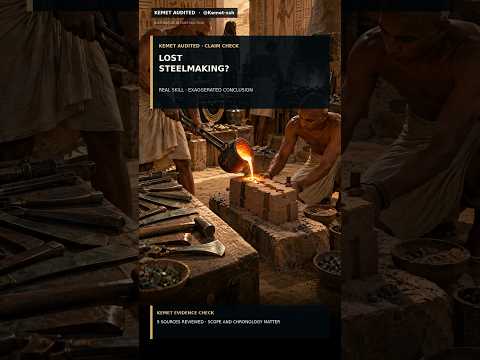
Was there ever an industrial steel-making industry in ancient Egypt?
There is no evidence in the archaeological record that ancient Egyptians practiced the industrial smelting or carbonization processes necessary to create steel. According to The Open University, the transition to terrestrial iron metallurgy occurred significantly later than the predynastic and pyramid-building eras. For the majority of Egyptian history, copper and bronze served as the primary metals for tools, weapons, and ornamentation.
While the craftsmanship of these periods was highly sophisticated, the mastery of the carbonization process required for steel production was not part of the documented metallurgical repertoire of the Old Kingdom. Steel is an alloy of iron and carbon, requiring specific temperature control and chemical interactions within a furnace—a process that leaves behind clear indicators in the archaeological record, such as slag heaps and specialized kiln components. None of these indicators have been found for the early periods of Egyptian history. Consequently, scholars maintain that the absence of these industrial markers indicates the absence of an industrial steel industry. It is important to address why this distinction matters: the absence of evidence for industrial steel production does not diminish the prestige of the Egyptian civilization, but rather emphasizes the different technological paths they pursued. The reliance on copper and bronze allowed for the construction of monumental architecture and the creation of intricate art. The claim that they used "industrial steel" often relies on misunderstandings of how bronze tools function, or on the misinterpretation of isolated meteoritic iron artifacts as signs of a broader, hidden industry. In the context of archaeological study, we rely on the presence of waste products, such as slag and furnace remains, to confirm industrial-scale production. Because these are absent for the Old Kingdom, the academic consensus remains that industrial steel was not part of their technological toolkit.
No academic evidence supports the claim that an industrial steel industry existed during the pyramid-building era.
Why are artistic depictions of metalworking sometimes misunderstood?
Ancient Egyptian scenes often depict artisans at work, leading some to interpret these images as literal engineering blueprints. Scholars emphasize that these depictions frequently carry symbolic or ritualistic meanings rather than serving as technical manuals. When viewing these reliefs, it is essential to distinguish between the artist’s intent to portray the status and divine nature of craft and the actual mechanical processes involved.
There is no source found that confirms these artistic depictions contained secret technological instructions for smelting steel. Often, the tools shown in these carvings were consistent with the bronze and copper technology of the time. When individuals interpret these images as evidence of advanced machinery, they may be projecting modern technological concepts onto ancient artistic representations. The depictions show the importance of the artisan in Egyptian society, but they do not show the furnaces or chemical processes that would define an "industrial" age of metallurgy. For instance, the use of bellows or specific types of crucibles in paintings is often cited as evidence of high-temperature work, yet this can just as easily be attributed to the casting of bronze. Misreading these artistic cues often stems from a modern desire to see ancient people as having "solved" metallurgical problems using techniques we recognize today. However, the archaeological record is the final arbiter. Even if an artist intended to capture a moment of technical expertise, that expertise was applied to the materials available, which were predominantly non-ferrous metals during the peak of the pyramid-building era. Understanding this prevents the projection of modern technological desires onto the ancient past and encourages a more nuanced look at the genuine achievements of the Old Kingdom.
Why does the distinction between meteoritic and terrestrial iron matter?
The study of these artifacts allows researchers to refine our understanding of how early metalworkers manipulated high-nickel alloys. The transition from harvesting "iron from the sky" to the eventual mastery of terrestrial smelting marks a significant milestone in human technological development. Understanding the genuine source of these materials prevents the misinterpretation of archaeological finds and honors the actual resourcefulness of ancient artisans.
By relying on chemical signatures rather than speculation, archaeologists gain a clearer picture of the technological history of the Nile Valley. This process matters because it changes how we view the evolution of human history. If ancient Egyptians had mastered steel in the Old Kingdom, the history of global technology would be completely different. By identifying the meteoritic source of these early items, we instead see a people who were deeply engaged with their environment and the natural materials they encountered, including those from the sky. This is a testament to their creativity and adaptive nature, proving they could manipulate even the most challenging materials without needing the industrial infrastructure of much later centuries. The distinction is not merely academic; it is about accuracy in the historical narrative. When we correctly identify an object as meteoritic iron, we are acknowledging that the ancient Egyptians were identifying and utilizing rare, exotic materials from their environment—a trait of an observant and highly skilled culture. This does not take away from their greatness; rather, it highlights their unique relationship with the materials available to them. It forces us to appreciate their mastery of bronze and copper as a fully developed technological system that defined their era, rather than viewing their history as a mere precursor to the Iron Age.
Distinguishing between meteoritic origins and terrestrial smelting is the only way to accurately map the development of metallurgy.
What remains unknown in the metallurgical record?
While we know the source of the iron was meteoritic, the precise artisanal techniques used to shape these specific meteorites into functional objects—such as the Tutankhamun dagger—in a pre-industrial setting are still being studied by materials scientists and archaeologists. We are left with questions about how these early craftspeople managed to heat and hammer such tough, high-nickel materials without the benefit of standard smelting techniques.
Furthermore, there is no academic support for the claim that "industrial steel" existed, but the ongoing analysis of rare iron samples continues to refine our understanding of how early metalworkers manipulated high-nickel meteoritic alloys before the mastery of terrestrial iron smelting. The exact nature of this "pre-industrial" technique remains a subject for further inquiry. We still need to understand the precise thermal thresholds required to work high-nickel iron without destroying the material’s structural integrity. Future research into the Khufu iron plate and other rare samples will continue to shed light on how these materials were integrated into Egyptian society. We do not yet know the full extent to which these meteoritic tools were used by the broader population versus the elite, or if there are other, as-yet-undiscovered caches of early metalwork waiting to be analyzed in museum storerooms or buried in the desert. Every new piece of data gathered through X-ray fluorescence or non-destructive analysis helps fill the gaps, but the archaeological record is inherently fragmented. We are effectively reconstructing a technological timeline using the smallest pieces of evidence, which means our current understanding remains a work in progress. What we know today may be refined by the findings of tomorrow, especially as analytical methods become more sophisticated and capable of identifying subtle chemical markers in increasingly corroded or small artifacts.
What should curious readers look for next?
Readers interested in the evolution of metalworking should monitor findings from ongoing metallurgical studies, which continue to utilize non-destructive analysis to examine museum collections. Those wishing to distinguish between myth and archaeological record can look to the publications of institutions like the British Museum and peer-reviewed journals like Meteoritics & Planetary Science.
These sources provide the most reliable data on the progression from meteoritic experimentation to the eventual, much later, Iron Age in Egypt. As non-destructive technology improves, we may be able to look at even smaller or more heavily corroded artifacts to see if they, too, share the metallic signature of the stars. In the meantime, the record remains clear: the ancient Egyptians were masters of their world and skilled artisans of bronze and copper, who held the rare, sky-fallen iron in high, sacred regard. The narrative of their ingenuity is not diminished by the lack of industrial steel; rather, it is enriched by the evidence of how they interacted with the rare, exotic materials that the earth provided them from above. Science continues to illuminate this story, one analysis at a time, moving us closer to a full understanding of the ancient Nile Valley. We should continue to look at these artifacts not as evidence of lost industrial miracles, but as the remains of a highly inventive, culturally rich society that saw, in the fallen iron of the heavens, a material worthy of their most dedicated and meticulous craftsmanship. The future of archaeology lies in this balance between acknowledging what we know for certain and remaining open to the new facts that modern science will eventually extract from these silent, metallic survivors of the deep past.
Watch the Kemet filmFirst published on Kemet (kemetstories.com) · reference KMT-0C17DD
← Back to the archive